
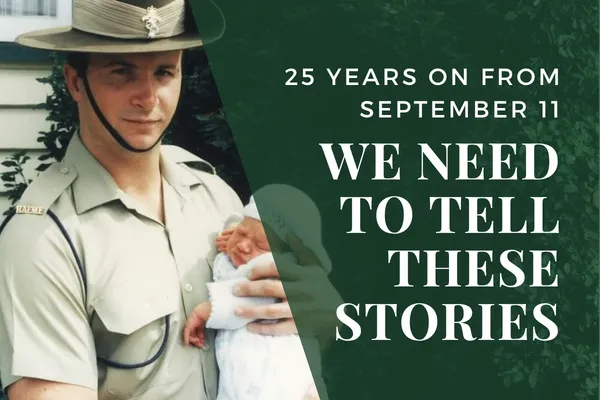
25 Years On From September 11: Why We Still Need to Tell These Stories
A note before we start: this piece touches on the September 11 terrorist attacks, including death, grief, trauma and the conflict that followed. If today isn't the day for it, that's completely okay. Come back to it whenever feels right.
"They remain alive as long as someone is still telling their story."
Twenty-five years ago today, the world changed in the space of a single morning. For most of the people reading this, September 11, 2001 isn't a date you need explained. You remember exactly where you were, even if, like me, you were too young to understand what you were looking at.
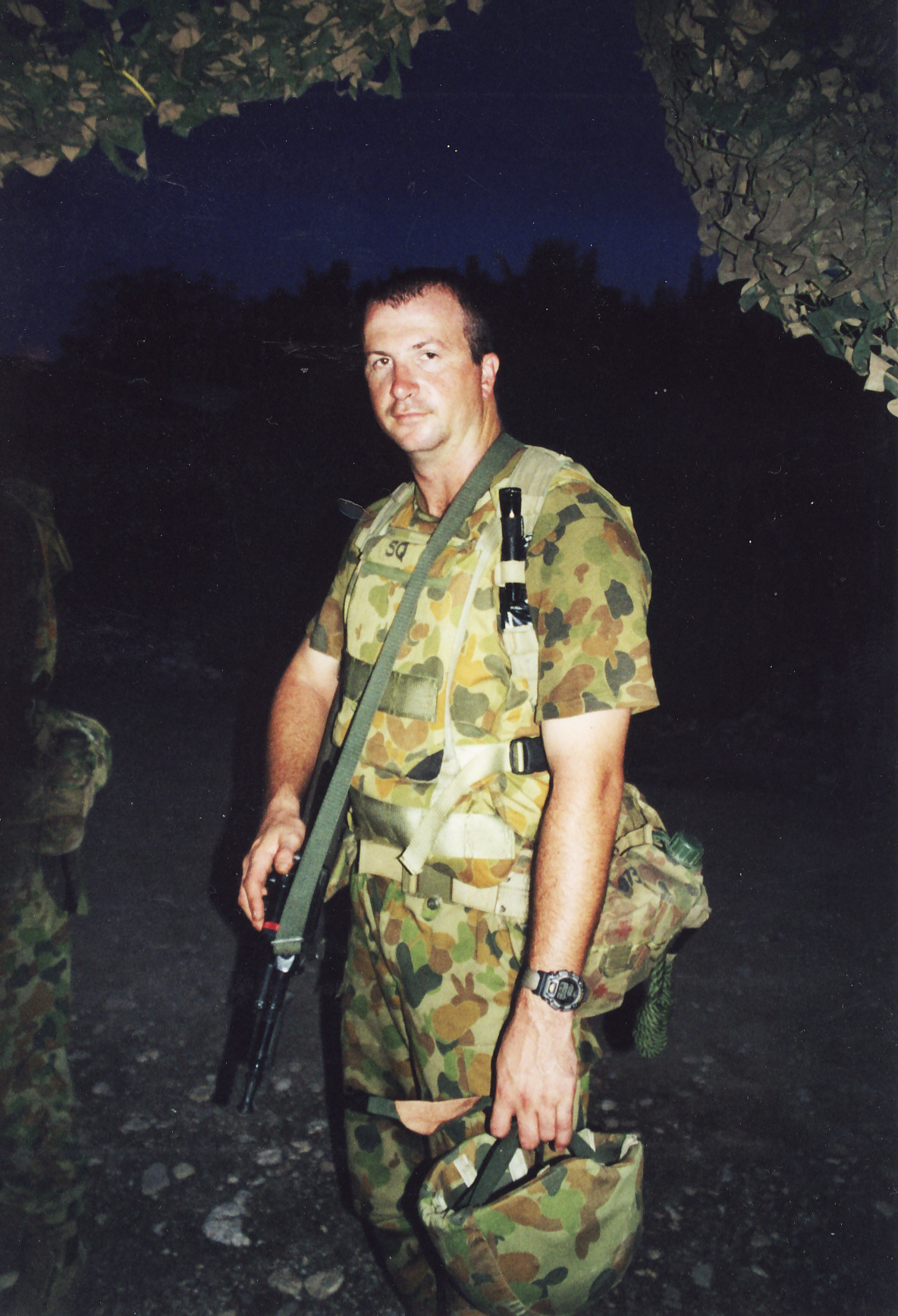
I was five years old, living in Townsville, Queensland. I have no memory of the attacks themselves. What I do remember, vividly, is that my dad had just landed home that same day after six months deployed to East Timor with the Australian Army on a UN peacekeeping mission.
It should have been one of the happiest days our family had that year. We were days away from a holiday to the Whitsundays. Instead, my parents woke the next morning to a world that had shifted overnight, and a homecoming that suddenly felt very small against what was unfolding on the other side of the planet.
I share that not because my family's story sits anywhere near the centre of what happened that day, but because it's the lens I've carried it through my whole life. And I think almost everyone has a version of that lens, their own small, personal thread tangled up in a history so much bigger than any one of us.
What actually happened that day
For anyone who needs the facts laid plainly: on September 11, 2001, four commercial aeroplanes were hijacked in a coordinated terrorist attack on the United States. Two hit the World Trade Center's Twin Towers in New York, both of which collapsed within hours. One struck the Pentagon. The fourth, United Flight 93, crashed in a field in Pennsylvania after passengers attempted to retake control. Almost 3,000 people were killed that day.
That number, close to 3,000, is only the beginning of the toll. In the years since, thousands more have died from illnesses linked to the attacks, from the wars that followed, and from the grief and trauma that don't show up in an official count. The loss stretches far beyond a single date on a calendar.
A generation that grew up in its shadow
Here in Australia, it was already night by the time the first plane hit. Many of us only found out the next day, through newspapers and television footage that, even filtered through distance and delay, was confronting enough to stay lodged in memory for decades. There was no social media to soften or accelerate the news. People were simply finding out, all at once, that the world looked different than it had the day before.
What followed reshaped global politics for a generation. The war on terror. The invasion of Afghanistan. The creation of entire government agencies that didn't exist before that morning. A rise in Islamophobia and racism that many communities are still living with the consequences of today. Waves of migration, displacement and grief that rippled far beyond American borders, including here at home, where so many Australian veterans would go on to serve in Afghanistan in the years that followed.
Twenty-five years on, there's now an entire generation who weren't alive when it happened, growing up in a world that was fundamentally built by that day's aftermath. It's worth sitting with that for a moment. History isn't always something that happened to someone else, a long time ago. Sometimes it's the reason the world looks exactly the way it does right now.
Why we keep telling this story
It would be easy to let a day like this pass quietly, especially twenty-five years on, when the immediacy of it has faded for so many people. But there's something I keep coming back to: the people who were lost that day stay part of the world for as long as someone is still telling their story. Not the trauma itself, but the fact that they existed, that they mattered, that their loss changed the people who loved them.
That's part of what drew me into journalism in the first place, long before I ever imagined starting my own business. A pull towards understanding why people do the things they do, including the unimaginable things, and towards making sure the stories behind the headlines don't get lost in the scale of the numbers. If you're after a deeper look, two documentaries are worth your time: Generation 9/11 (Turning Point, streaming on Netflix), which looks at how the world reshaped itself in the decades since, and National Geographic's 9/11: A Day in America, which tells the day through first-hand accounts from the people who actually lived it.
This is a heavy topic, and there's no tidy way to close a piece like this. So I won't try to. I'll just say that this anniversary, and every one before and after it, is worth pausing for. For the people who were there. For the people who lost someone. For everyone still carrying what came after.
If you'd like to hear the fuller reflection, Episode 2 of The Story Lounge Podcast, Never Forget: 25 Years On From 9/11, is live now on YouTube and Spotify. Please look after yourself while you listen.